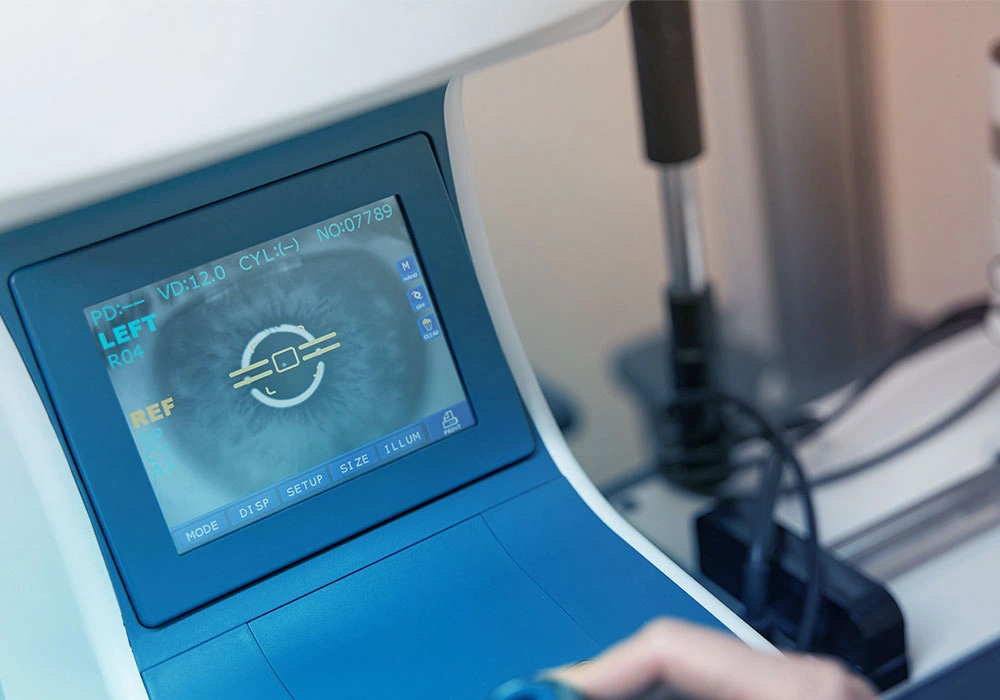
Last updated: 18/12/2025
Thinking about LASIK, PRK, SMILE, or another vision correction procedure? This guide walks through what a refractive surgery evaluation typically includes, why it matters for safety and results, and how to prepare—especially in the UAE, where air-conditioning, screen time, and night driving can highlight dry-eye and glare symptoms.
A refractive surgery evaluation is often the most important step before deciding on laser vision correction. It helps your ophthalmologist understand your prescription, corneal health, and overall eye condition—so you can choose an option that’s appropriate for your eyes and your day-to-day needs.
for refractive surgery and discuss the options with an eye specialist. Book a consultation at Magrabi Hospital in the UAE to review your suitability.
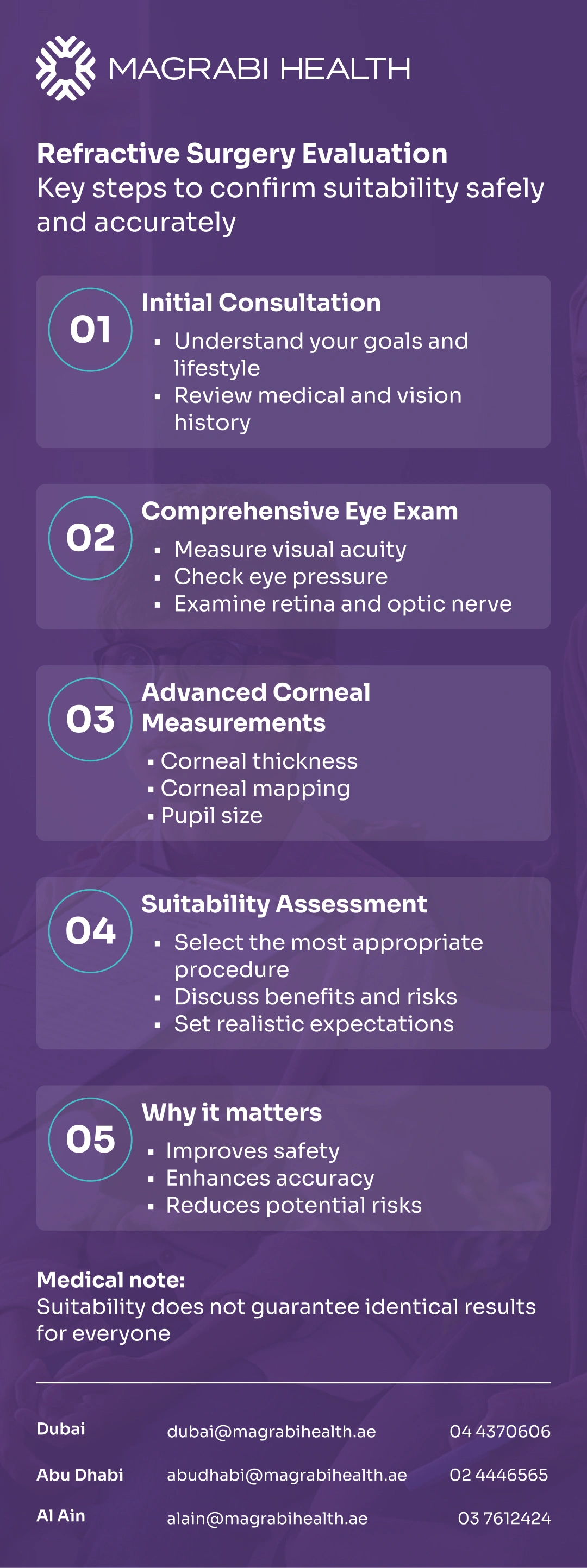
A refractive surgery evaluation is a structured set of tests and medical questions done before procedures such as LASIK, PRK, or SMILE. The goal is to determine whether surgery is likely to be safe and effective for you, and to set realistic expectations for vision after treatment.
It’s more than “checking the glasses prescription.” The evaluation also looks closely at the cornea (its shape and thickness), the ocular surface (including dryness), and the health of the retina and optic nerve.
A detailed evaluation reduces avoidable risk and improves planning. Some important factors—like irregular corneal shape, untreated dry eye, or pressure-related issues—may not be obvious without targeted measurements.
It also helps you make a confident decision by discussing real-world outcomes: for example, some people still need reading glasses with age (presbyopia), and some notice glare or halos at night—an important consideration if you drive frequently after dark.
A refractive surgery evaluation at Magrabi typically follows a clear, step-by-step process.
It starts with understanding your vision goals and lifestyle, then moves into detailed eye and corneal testing to confirm safety and plan treatment accurately.
The aim is to determine whether you’re a suitable candidate and to match you with the most appropriate option—while setting realistic expectations for outcomes.
Here are the steps in detail:
Your visit usually starts with a conversation about your goals and lifestyle. Your doctor may ask how much you rely on glasses or contacts, whether you drive at night, and how your eyes feel after long hours on screens.
You’ll also review your general medical history, medications, and any eye symptoms. This context helps interpret the test results and identify factors that could affect healing or visual quality.
A full eye exam provides the clinical foundation for any refractive surgery decision. It checks overall eye health and helps rule out issues that could change the plan.
Visual acuity and refraction: to measure your prescription accurately.
Eye pressure measurement: to screen for pressure-related concerns.
Retina and optic nerve check: often with pupil dilation when appropriate, to assess the back of the eye.
Corneal measurements are central to refractive surgery planning. They help confirm that the cornea’s shape and thickness can support a safe, well-calculated treatment.
Corneal thickness assessment (pachymetry): helps determine how much corneal tissue can be reshaped safely.
Corneal topography and tomography: maps corneal curvature and structure to detect irregularities.
Pupil size analysis: especially in dim light, because pupil size can be related to night-vision symptoms like glare or halos.
Your ophthalmologist may also evaluate the tear film and ocular surface, because dryness can affect comfort, measurement accuracy, and visual stability after surgery.
Once the results are in, your doctor will explain whether you’re a suitable candidate and which procedure may fit best (LASIK, PRK, SMILE, or another option), based on your prescription, corneal measurements, ocular surface health, and expectations.
A key part of the evaluation is informed decision-making: discussing potential side effects (such as dry eye), visual symptoms (such as halos), and the possibility that you may still need glasses in some situations or for reading as you age.
You can also visit Refractive and Cornea Care service page on Magrabi Health’s website to learn about available options and book an appointment.
Not being suitable for one procedure doesn’t mean you have no options. Sometimes the reason is temporary—such as untreated dry eye—and your doctor may recommend treatment first and then repeat key measurements.
In other cases, alternatives may be discussed depending on your eyes and age, such as surface laser procedures (like PRK), implantable contact lenses (ICL), or lens-based options. Your ophthalmologist will explain the trade-offs and what’s safest for you.
Good preparation helps your doctor get accurate measurements and makes your visit more efficient—especially if you wear contact lenses.
Pause contact lens wear before your evaluation: contact lenses can temporarily change corneal shape. The U.S. FDA notes that you may need to stop soft lenses for about 2 weeks before the baseline evaluation, toric soft or rigid gas permeable lenses for at least 3 weeks, and hard lenses for at least 4 weeks (your doctor will advise what applies to you).
Bring your current glasses/contact prescription: it helps document your baseline and whether your prescription has been stable.
List medications and health conditions: including eye drops and any conditions that could affect healing.
Plan for possible pupil dilation: if your pupils are dilated, vision may be blurry for a few hours—consider arranging a comfortable way home.
If you develop urgent symptoms at any time, don’t wait for a routine appointment.
Severe eye pain or rapidly worsening redness
Sudden drop in vision or a “curtain/shadow” in your visual field
New flashes of light or a sudden increase in floaters
Thick discharge or significant light sensitivity
A refractive surgery evaluation is designed to answer two practical questions: is laser vision correction appropriate and safe for your eyes, and what outcome is realistic for your lifestyle? With thorough testing and clear expectations, you can make an informed choice—whether that leads to refractive surgery or an alternative plan.
Book a refractive surgery evaluation to take a safe, informed next step toward clearer vision.
Reviewed by Dr. Moataz Sallam, Consultant Cataract, Refractive and Anterior Segment Surgeries, with 20+ years of experience in phaco-refractive and cornea care in Dubai and Al Ain.
This article is for general health education and does not replace a medical consultation, diagnosis, or treatment plan. Suitability for refractive surgery varies from person to person, so please see an ophthalmologist for an individualized evaluation.
U.S. Food & Drug Administration (FDA) — LASIK: what to expect and baseline evaluation guidance; LASIK surgery checklist.
American Academy of Ophthalmology (AAO) — what to expect before LASIK; refractive surgery practice guidance (PPP).
NHS (UK) — laser eye surgery and lens surgery overview and potential complications.
The Royal College of Ophthalmologists (RCOphth) — patient resources and refractive surgery information.